Language
  EN
EN RU
RU ES
ES DE
DE EL
EL IT
IT JA
JA KO
KO PT
PT ID
ID SR
SR UK
UK VI
VI TH
TH TR
TR MS
MS BE
BE AR
ARHot Retreading vs. Cold Retreading: Key Differences in Tire Retreading Processes
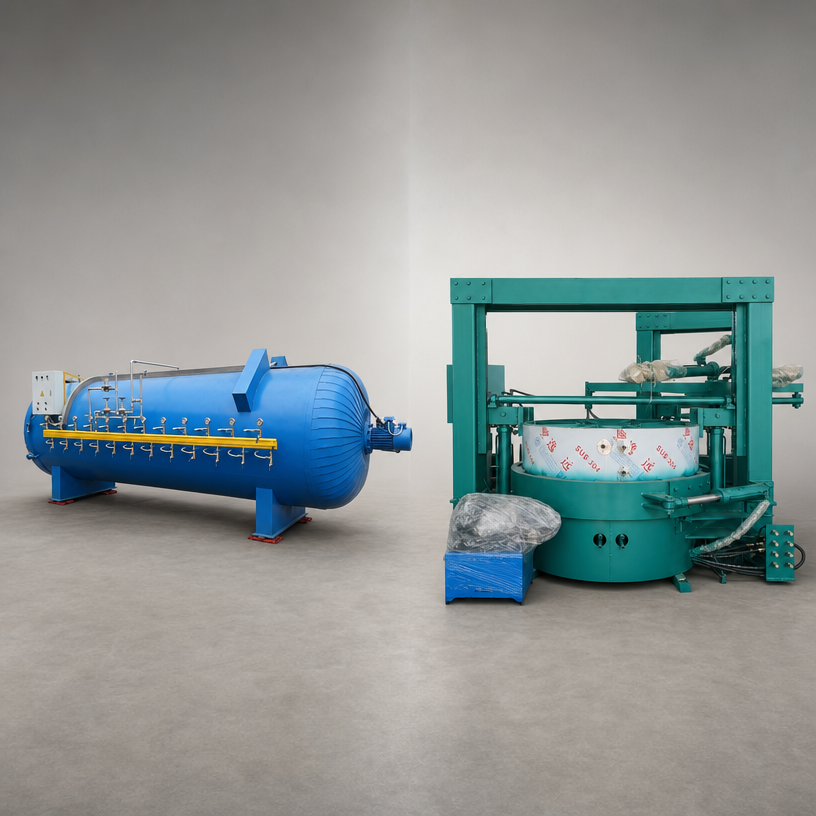
Hot Retreading vs. Cold Retreading: Key Differences in Tire Retreading Processes
Hot retreading and cold retreading are two fundamentally different tire-retreading processes. The core difference is whether the tread rubber is vulcanized and molded in advance.
The following comparison focuses on the aspects that matter most to your business, including equipment, costs, and application scenarios.
Fundamental Differences in the Processes
Hot Retreading — Mold Cure
In hot retreading, unvulcanized rubber is applied to a buffed tire casing. The casing is then placed into a metal mold with the desired tread pattern, where it is vulcanized and molded under high temperature and pressure, typically at 140–155°C.
The mold forms the tread pattern during vulcanization.
Cold Retreading — Pre-Cure Retreading
In the cold-retreading process, the tread rubber is vulcanized in advance at a factory and manufactured into a finished, patterned tread strip.
The pre-cured tread is then applied to a buffed tire casing using a layer of unvulcanized cushion gum and adhesive. The assembly is placed into an autoclave, where it is bonded and vulcanized at a lower temperature, generally 95–115°C.
In this process, the tread pattern is formed in advance during the production of the pre-cured tread.
2. Comparison of Key Performance Indicators
3. Market Trends and Applications
Internationally, cold retreading has become the dominant process for commercial truck and bus radial tires in markets such as the United States, France, and Japan. Hot retreading has gradually declined in these markets.
In China, hot retreading remains an important process, but the share of cold retreading is increasing rapidly. Cold retreading continues to gain market share globally, particularly in the commercial truck and bus tire segment.
In simple terms, cold retreading is the preferred choice for most commercial truck and bus tires because it is gentler on the casing, supports multiple retreading cycles, offers greater tread-pattern flexibility, and can provide better overall profitability.
Hot retreading is more commonly used for specific tire categories, including OTR tires, mining tires, agricultural tires, and bias-ply tires.
Conclusion
The choice between hot retreading and cold retreading depends primarily on the tire type, casing condition, production capacity, equipment investment, and target market.
Hot retreading is suitable for applications that require molded tread patterns, especially OTR, mining, agricultural, and bias-ply tires
Cold retreading is generally more suitable for commercial truck and bus radial tires, especially when casing protection, repeated retreading, fuel efficiency, and tread-pattern flexibility are important considerations.
In practice, cold retreading is becoming increasingly important because it offers a better balance between casing life, operating efficiency, environmental performance, and long-term business profitability.
GET IN TOUCH
- Call Now+86-18866769106
- Chat Now+86-18866769106
- Mail Nowpangxuemei_cn@outlook.com
- AddressNo.156 Donghuan Road,Zhucheng City,Shandong Province,China.